The HUD
Seven real zone examples. Each one answers the same four questions: where, what, how serious, and what to do.
The FarmHUD heads-up display is not a list of alerts. It is a spatial intelligence layer — every event placed in context, classified by the system, and surfaced with a clear recommended action. These are examples from a live installation.
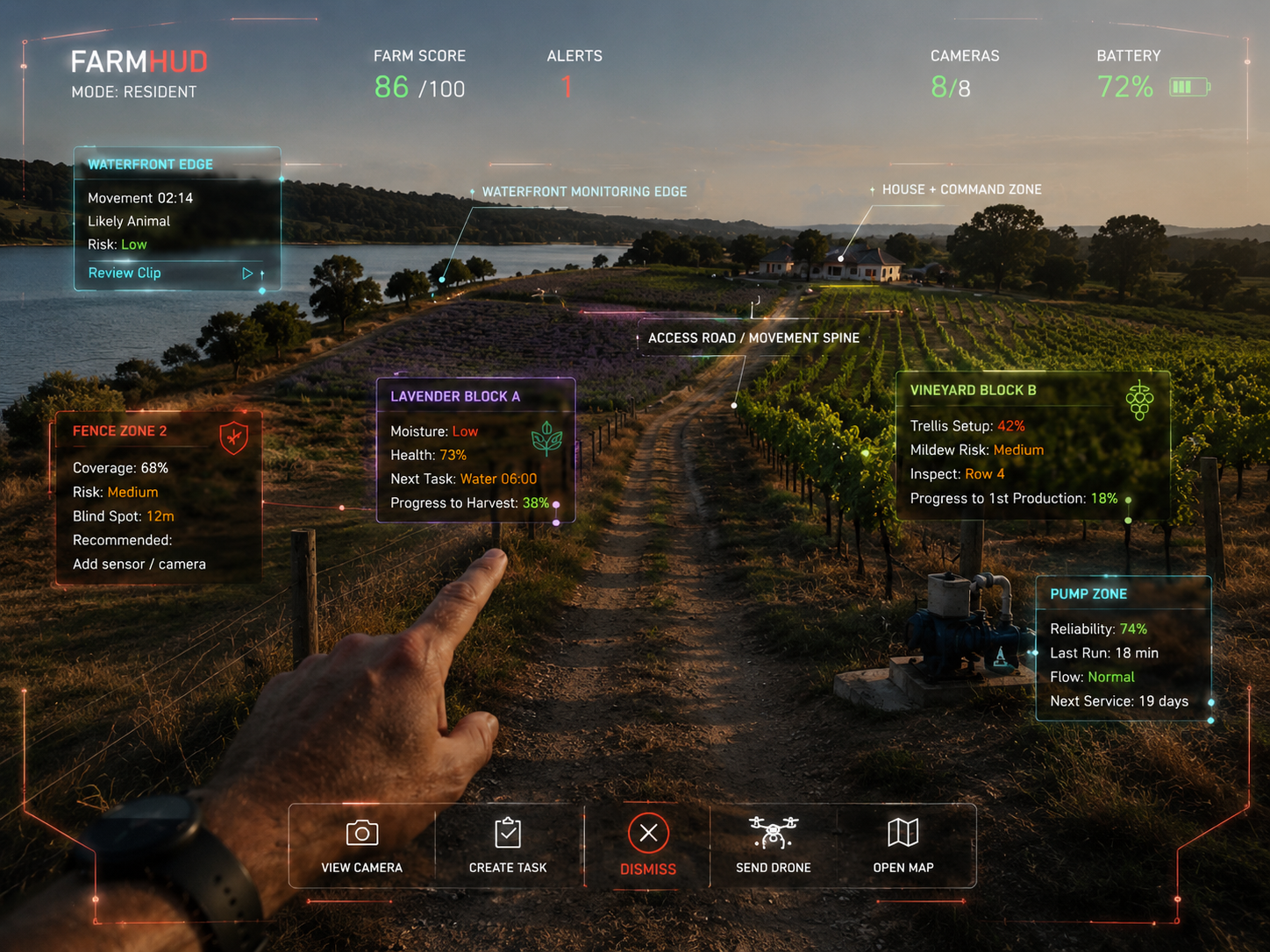
First-person view
This is what the HUD looks like.
Not a dashboard on a screen. Not an app on your phone. A spatial intelligence layer rendered inside smart glasses — zone overlays anchored to the real land, live status data floating where it belongs, and contextual actions available at a glance.
Each zone card is positioned where the physical zone exists. The data updates in real time. The actions are accessible without looking away from the property.
What you see in the lens
- Farm score and active alerts at a glance
- Zone overlays anchored to real-world positions
- Severity-coded data: moisture, risk, health, coverage
- Recommended actions surfaced in context
- Quick commands: view camera, create task, send drone
Actual FarmHUD concept view: a bespoke HUD layer built around our first 5-hectare waterfront test farm.
Gate
OPEN
Duration
31 min
Last exit
ute / matched
Unknown approach
1
Camera
online
Plate reader
active
Where is it?
South-east boundary. Main vehicle entry. Mounted camera at 4.2m, plate reader active, electromagnetic gate latch.
What happened?
Gate open for 31 minutes. Last recorded exit: Ute — matched plates — 31 min ago. No return trip detected. No scheduled open window active. Unknown vehicle approached from road at 14:22 but did not enter.
How serious is it?
An unattended open gate is a critical security and containment event. Stock escape risk is active. Unknown vehicle approach compounds the alert. This is the highest priority alert state in the security layer.
What action should be taken?
Confirm gate status via camera feed. If no authorised activity, close gate remotely or dispatch to site immediately. Review plate-reader log for unknown vehicle. Log response time.
Event
23:11
Classification
unclear (67%)
Follow-up movement
none
Tide
incoming
Camera
online
IR sensors
3 active
Where is it?
Northern boundary edge. Tidal waterfront, ~180m of exposed shoreline. 1× wide-angle PTZ camera, 3× passive IR sensors mounted on boundary posts.
What happened?
Movement detected at the waterline at 23:11. Classification: unclear — possible person, possibly large waterfowl. Single event, no follow-up movement. Tide was incoming at time of detection.
How serious is it?
Waterfront events at night carry elevated weight regardless of classification. The ML model has lower confidence in this event (67%) due to tidal movement interference. Not a confirmed intrusion, but the alert is genuine.
What action should be taken?
Review PTZ footage from 23:11. If person confirmed, escalate to critical. If wildlife, mark as false positive and use to retrain the waterfront model. No immediate physical response required unless confirmed human activity.
Section
C — West
Voltage
4.8kV (was 7.2kV)
Energiser output
normal
Duration of drop
47 min
Stock proximity
60m
Last inspection
2 days ago
Where is it?
Western boundary, Section C. 180m electric fence between paddock 3 and the neighbour's property. Voltage sensor at midpoint and at the energiser output.
What happened?
Voltage on Section C dropped from 7.2kV to 2.1kV at 09:44. Duration: 47 minutes. Voltage has since partially recovered to 4.8kV. Energiser is reporting normal output. Drop is likely a partial earth or vegetation contact.
How serious is it?
Below 3kV the fence is not an effective deterrent for cattle. A partial earth can become a full break. The stock in paddock 3 are currently 60m from the affected section. Risk of escape is low but rising with time.
What action should be taken?
Walk Section C from the energiser outward. Look for grass, branches, or fallen timber contacting the wire. Clear any vegetation contact. If the wire is broken or a post is down, repair before moving stock near the section.
Block
4 — Shiraz
Stage
Veraison
Row 3 moisture
28%
Row 6 moisture
41%
Humidity tonight
>88%
Botrytis pressure
elevated
Where is it?
Block 4 — Shiraz, south-east sector. 6 rows, 220 plants, currently at veraison. Soil moisture sensor at row 3 and row 6. Weather station 40m north-west.
What happened?
Soil moisture in row 3 dropped below 28% at 06:10. Row 6 is at 41%. Last irrigation event was 3 days ago (scheduled, 40 min run). High humidity forecast for tonight (>88%) combined with elevated botrytis pressure index.
How serious is it?
Moisture deficit during veraison directly affects berry set and sugar accumulation. The humidity forecast increases botrytis risk significantly in a moisture-stressed vine. This is a time-sensitive agronomic decision.
What action should be taken?
Run a targeted irrigation cycle on rows 1–4 for 25 minutes before 14:00 to avoid adding humidity before the overnight forecast. Schedule a botrytis spray for tomorrow morning. Log action against Block 4 growth record.
Runtime
4h 12m continuous
Schedule active
none
Tank level
94%
Outlet pressure
−10%
Float cut-off
not triggered
Power draw
2.4kW
Where is it?
Pump house, central water system. Main electric pump supplying house, stock troughs, and irrigation header. Pressure transducer on outlet line, current sensor on power feed.
What happened?
Pump running continuously for 4 hours 12 minutes. No irrigation schedule active. Tank float sensor reports tanks at 94% — pump should have cut off at 95% as designed. Outlet pressure is 10% below normal operating pressure.
How serious is it?
A pump running outside its schedule with no demand and normal tank levels is a strong indicator of a leak on the supply line, a failed float valve, or a pump control fault. Continuous running will damage the pump motor within hours.
What action should be taken?
Switch pump to manual-off immediately via the HUD control or breaker. Inspect float valve in header tank. Walk the supply line from the pump house to the tank for signs of running water or wet ground. Log fault and do not restart until cause is identified.
Generation today
18.4 kWh
Current output
3.1kW
Battery
78%
Grid export
active
HUD system load
210W
UPS autonomy
38hr
Where is it?
Rooftop array — 14 panels, 5.6kW peak. Battery bank: 10kWh usable, 78% charge. Inverter in plant room, grid-connected with export metering.
What happened?
System operating normally. Generation today: 18.4 kWh. Current output: 3.1kW (partial cloud). Battery at 78%. Grid export active since 10:40. Camera network and HUD base station drawing 210W combined — within normal range.
How serious is it?
No fault condition. This is a status card. The HUD surfaces infrastructure health data continuously so that any deviation from normal is immediately visible against a known baseline.
What action should be taken?
No action required. Battery will reach full charge by approximately 15:30 based on current generation forecast. UPS autonomy at current load: 38 hours. Last inverter service: 4 months ago — schedule next service within 60 days.
Worker
J. Marais
Zone
Block 2 only
Task
Shoot thinning R1–12
Progress
7 of 12 rows
Last ping
11:22
Zone violations
0
Where is it?
Block 2 — Chardonnay, east paddock. Worker: J. Marais. Task assigned 07:30. Zone: crop blocks only. Restricted from: gate, command zone, waterfront.
What happened?
J. Marais checked in at 07:34. Current task: canopy management — shoot thinning, Rows 1–12. Progress logged via mobile HUD: rows 1–7 complete. Estimated completion: 13:45. Last location ping: Row 8 at 11:22.
How serious is it?
Normal operational status. Worker is on schedule, within assigned zone, and task is progressing as expected. No access violations or safety events recorded today.
What action should be taken?
No action required. Task completion will be confirmed when J. Marais marks rows 1–12 done in the HUD. Owner will receive a completion notification. Work record will be attached to the Block 2 canopy management log.
Why this matters
An alert without context is just noise.
Every FarmHUD zone card is designed around one principle: the person looking at the HUD should immediately understand what is happening, why it matters, and what to do about it. Not a raw sensor reading. Not a generic motion alert. A contextual, classified, actionable event.
The four-question format — where, what, how serious, what action — is the core structure of every HUD event card, whether it appears on a screen, a tablet, or a pair of heads-up display glasses.
Where is it?
Precise location on the property map — zone, section, sensor position. No ambiguity about which gate, which fence section, which block.
What happened?
A plain-language description of the event, including relevant context from the data layer — duration, classification confidence, historical patterns.
How serious is it?
A severity classification (Critical / Elevated / Normal / Info) with reasoning — not just a colour, but an explanation of what the severity means for this zone and this event.
What action should be taken?
A specific recommended next step, not a generic instruction. Based on the zone type, the event, and the time of day.
Build your HUD
Every HUD is built around one property. Yours would look different to these.
The zones, the alert thresholds, the severity logic, and the action recommendations are all configured from scratch for your land, your operation, and your priorities.